
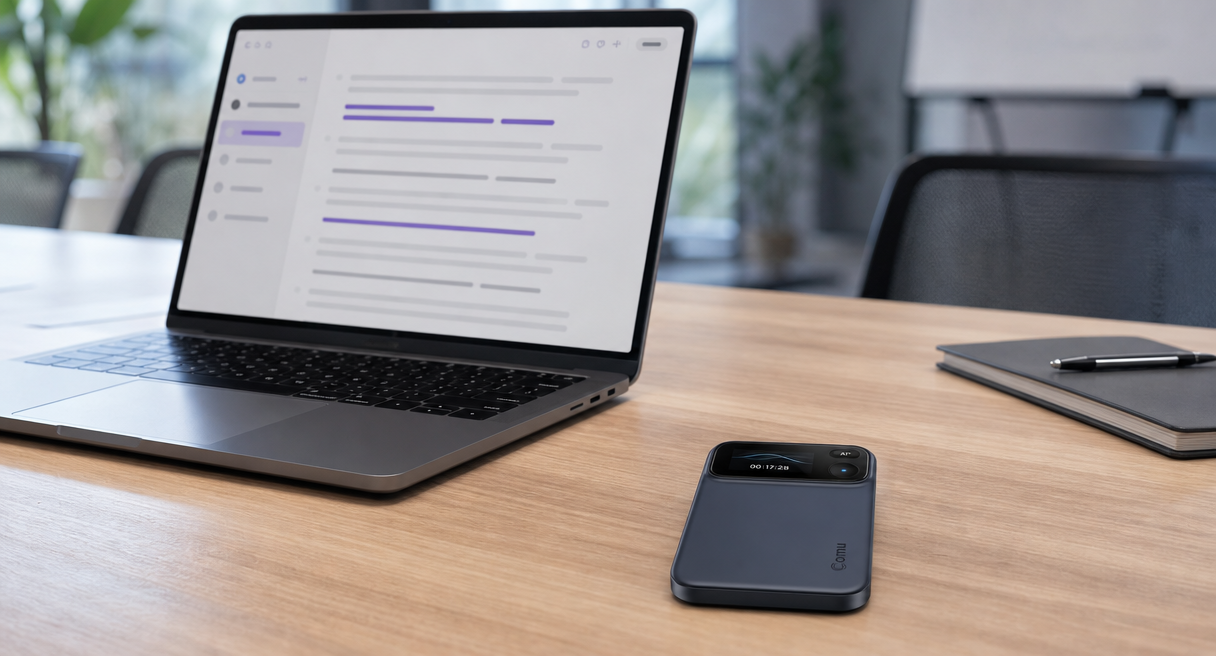
The best free meeting transcription platform search usually starts at a price of zero and ends at a quality question, because platforms that can transcribe and platforms whose transcripts survive a real meeting are not the same set. This guide separates the two first, then prices what a transcription platform free tier actually covers, by meeting frequency and language load rather than by brand.
Free tiers may be sufficient for some meeting schedules, but their limits vary by provider, including transcription minutes, meeting length, file uploads, languages, exports, and AI features. Frequent or long meetings make those limits more important, while a hardware-fed workflow may be preferable when in-room capture quality is the main constraint. The five acceptance checks below decide which side of the meeting transcription comparison a reader lands on.
Five Acceptance Checks for Transcription Quality, Scored on One Real Meeting
Can transcribe and worth using are different claims, and five checks separate them. Proper names and terms, numbers and dates, speaker separation, playback alignment, and language conditions form the scorecard, every platform faces the same five rows, and one real meeting supplies the only honest score.

Each check earns its row through a meeting-room consequence. Proper names and terms decide whether the account lead and the project code arrive intact in the minutes. Numbers and dates are the least forgiving cells in any decision record, because a wrong figure travels straight into commitments. Speaker separation answers the question every follow-up depends on, who said what, with attributable lines instead of one merged voice. Playback alignment lets a disputed sentence be traced back to its source audio in seconds during review.
Language conditions cover accents and mixed-language meetings, where transcription support across 113 languages exists in the dedicated class per Comu's official specifications. One boundary statement belongs in plain terms, Some vendors publish transcription accuracy figures, but test conditions differ and the results may not be independently verified or directly comparable.
A representative meeting remains the most useful practical test. online-first calendars can stay with software platforms, while rooms, several speakers, and multilingual load point toward the hardware-fed chains below.
Input Quality Decides Transcription Quality
Transcription is manufacturing, and the audio is the raw material, which is why the same platform scores differently across rooms. Noise reduction that feeds the engine cleaner input and microphone arrays that give each voice its own channel set the ceiling before any algorithm runs.

The mechanism deserves its own section because free-platform comparisons routinely skip it.
The category's own function descriptions make the chain explicit, AI noise reduction is positioned to reduce environmental noise and improve AI understanding, which means the noise-reduction step serves the transcript rather than the listener's ear alone, and multi-microphone adaptive arrays exist to lift voice capture in multi-person and complex environments, helping capture voices from different positions in the room more consistently than a single phone or laptop microphone, although overlapping speech and room acoustics can still affect the transcript.
Garbage in, garbage out is the compressed version, and it explains the pattern most teams have already noticed, the same platform that scores well in a quiet two-person call produces messy text in a conference room, not because the algorithm changed, but because the raw material did. Any evaluation that ignores the input side scores the wrong half of the problem, and any platform decision made only on quiet test calls inherits that gap.
Three Platform Shapes and the Math of Free Tiers
Platform shapes differ more than price tags do, so the comparison covers three, pure software platforms, meeting-integrated tools, and hardware-fed workflows. Free tiers are real but metered by duration, words, or seats, generous for short low-frequency meetings and quick to run dry under long, frequent, multilingual load.
The best free meeting transcription platform for a given team is decided less by brand than by the shape of its meetings, so the three shapes deserve one honest line each. Pure software platforms transcribe uploaded or live audio on a subscription logic, with free tiers metered by duration, volume, or seats. Meeting-integrated tools embed transcription inside the online meeting itself, which removes one upload step and binds the choice to the meeting suite already in use.
Hardware-fed workflows pair a dedicated recorder with the transcription and summarization chain, which moves the input problem out of the laptop microphone and into an array built for rooms. The math of free follows the meter, an allowance that lasts a quarter at two short meetings a week can vanish in days under daily long sessions, and multilingual meetings add their own load. Allowance structures vary across platforms and can become restrictive for frequent, long meetings. Comu Starter avoids minute-based transcription limits for real-time use.
The category map stays equally restrained, the hardware-plus-AI-notes category currently has several makers, and no comparative conclusions about their transcription internals are drawn here.
After the Transcript: The Output Chain Is Where a Platform Earns Its Place
A transcript is an intermediate step rather than the final deliverable. Comu Action Pro combines real-time transcription in 113 languages with playback highlighting, translation, summaries, action lists, emails, and CRM-note drafts.
The official output list reads like a desk check for what meetings actually produce. Transcription support spans 113 languages per Comu's official specifications. Real-time transcription turns speech into text while the meeting runs, with the text highlighting in step with playback. Translation flows in two steps, choose a language, then view the translated conversation, and the review items check that names, brands, and numbers survive the translation.
The deliverables are named, an AI summary of five elements, key points, meeting notes, action items, decisions, and follow-ups, an action list identifying owners, decisions, deadlines, and next steps, a follow-up email of six elements, recipients, subject, summary, decisions, action items, and deadlines, CRM notes capturing client needs and follow-ups, and smart organization through colored tags, classification, and a searchable history.
A professional reviewer's warning sentence doubles as the acceptance test for any of it, Suggestions incorrectly written as decisions, or discussions presented as commitments. Run that test on one output before trusting any platform's minutes. Comu states that AI-generated summaries and other outputs may require review and adjustment before final use. The Comu Action Pro product page carries the full specifications.
Cost Structure and the Decision: Low-Frequency Short Meetings vs High-Frequency Long or Multilingual Ones
The Comu-side ledger is short and checkable, a one-time hardware purchase with the current price on the official product page, the free Starter plan with unlimited real-time AI transcription and basic summaries, and optional Premium and Elite subscriptions whose current prices sit on the live store and app pages. The decision then follows frequency and language load, two decision factors with no single answer.
The cost has three parts. The hardware is a one-time purchase, with the current price shown on the official product page. After purchase, the free Starter plan includes unlimited real-time AI transcription and basic summaries, and Premium and Elite are optional upgrades with higher Agent Credit allowances and expanded access to advanced AI features and workflows, obtained by downloading the Comu app and subscribing in it, where current prices display before checkout.
Teams with one or two short meetings a week are well served by a free tier and its conditions, while teams with daily long sessions or multilingual meetings should price their per-minute totals for a quarter and set that against a once-plus-subscription structure before choosing. The next step is one real meeting scored on the five checks, terms, figures, speakers, alignment, and language, because a single scored transcript settles more than any feature table.
Free tiers can work when their limits match the meeting schedule, while dedicated hardware becomes more relevant when room coverage, recording duration, or interruption risk is the main concern. The official product page and the full AI transcription and summarization feature guide carry the deeper comparison.
The best free meeting transcription platform question closes on one scored meeting, and the five checks above turn price into evidence.
