
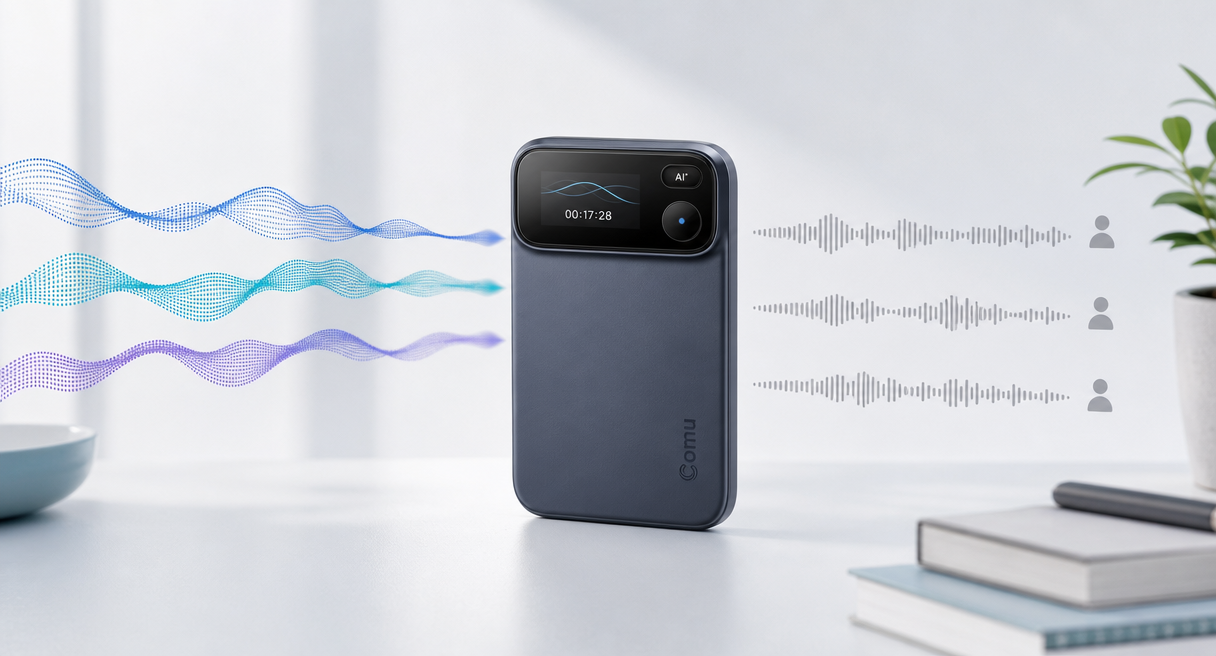
A three-person review call, one page of minutes, a line in the wrong column. The recorder caught every word, yet the action item landed under the wrong name, and the real owner found out a week later. Transcription was never the broken part. Attribution was.
A voice recorder with speaker identification labels who said what in meetings, which can help keep action items and decisions associated with the correct speaker, subject to review. Researchers call the underlying task speaker diarization, and its formal definition reduces to one question, who spoke when. Meeting attribution is what that answer buys you on a page of minutes.
This guide covers what speaker separation adds to a plain transcript, why overlapping speech is the real exam, and how to compare recorders when nobody publishes accuracy numbers.
What Speaker Identification Adds to a Voice Recorder
Speaker identification turns a transcript into an accountable record. It anchors the capability in its research definition, translates it with a lyric-sheet analogy, and follows each piece to its failure mode, because knowing what breaks tells you what to test before money changes hands.
A Microsoft Research review defines speaker diarization as "a task to label audio or video recordings with classes corresponding to speaker identity, or in short, a task to identify 'who spoke when'." The capability grew up inside multi-speaker speech recognition and now stands alone, feeding speaker metadata to downstream tasks. Your meeting minutes are one of those customers.
A plain transcript is like copying out the lyrics of a song sung by three voices, every word present, every line unattributed. Speaker identification is the copy that also marks who sings each line. When the marking works, action items carry owners. When two people talk at once and the labels swap, one person's commitment lands on another's page, and everything downstream inherits the error.
How to Test It: Overlapping Speech Is the Real Exam
Overlapping speech is one of the hardest conditions for any speaker-identification system. Comu combines a six-microphone adaptive array, AI noise reduction, and playback-synced transcripts to make attribution easier to review.

Speaker identification quality shows up when people talk over each other, so test recorders with overlapping speech before trusting the labels. A Microsoft Research paper from Interspeech 2022 builds a streaming model to attribute who spoke what at low latency while several people talk at once, the hardest case is the one the field still works on.
Comu Action Pro is built for multi-speaker environments with a six-microphone adaptive array, AI noise reduction, and pickup up to 7 meters. Its playback-synced transcript makes it easier to review proper names, technical terms, numbers, dates, accents, and mixed-language speech.
The same guidance recommends tests with three or more speakers at different distances, background noise, interruptions, and overlap. The final section turns that into your audition. One boundary belongs here verbatim. "Comu Action Pro uses AI technology to process conversations and generate summaries, emails, presentations, and other content.
AI-generated results are intended to assist users and may require user review and adjustment before final use." A Digital Trends review of Comu's Note Pro line adds the sharper caution, that "transcription quality and speaker identification are not the same thing."
Comparing Recorders Without Published Accuracy Numbers
Comparison in this category runs on provable facts and honest silences. Scenario by scenario, each recorder earns its place on capture hardware, published capability wording, and what independent reviews measured, while empty accuracy columns stay marked as unpublished rather than filled with hopeful guesses.
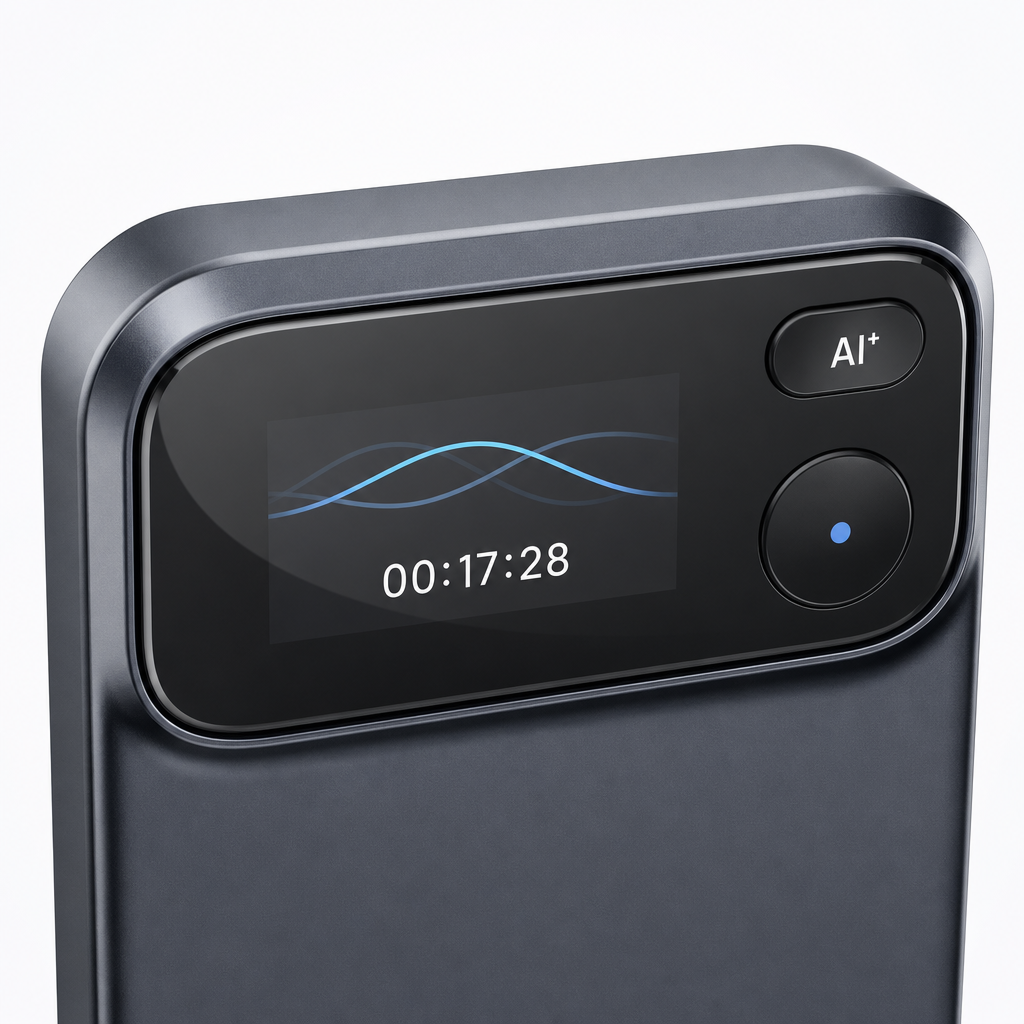
Judge a voice recorder with speaker identification through a real three-person meeting with interruptions, because spec sheets rarely publish accuracy numbers. The parameter tables that circulate list features and stay silent on separation performance, and an honest comparison marks that silence as unpublished rather than reading it as zero or victory.
Scenarios hand out the criteria. In a multi-person conference room, weight separation under overlap and pickup radius first, since distance and crosstalk decide whether labels survive. For calls, weight interruption handling, since phone recordings "can be interrupted by incoming calls and notifications," and a handset's microphones "often prioritize whichever voice is closest rather than capturing an entire discussion consistently." In an interview, weight turn-taking fidelity, the easiest case for labels and the fastest place to spot trouble.
The Comu Action Pro answers the conference-room scenario with the microphone array and noise reduction above, transcription in 113 languages, text appearing while the recording runs, and a transcript that highlights in sync with playback, so you can jump to the moment a line was spoken and check who said it.
FAQ: Labels, Phone Calls, and Corrections
Three edge questions cover most of what buyers ask about labeled transcripts. The answers lean on official wording and one independent review, they skip percentages nobody publishes, and where capability wording ends they say so instead of guessing past it.
What happens when two people talk at once?
Overlap is the hardest case, and the honest expectation is that labels can swap when voices collide. The official test conditions include interruptions and overlap precisely because of that, so run the three-person audition below before trusting any device, and treat capability wording as the ceiling of a vendor's claims.
Does speaker identification work on phone calls?
The official argument for dedicated hardware starts on the phone, recordings "can be interrupted by incoming calls and notifications," and handset microphones favor the closest voice. The Action Pro is optimized for face-to-face conversation, and Comu's target-customer scope names phone use among its scenarios, so test one real call and let the transcript argue for itself.
When the labels are wrong, how do I fix them?
Correction runs through the playback link. The transcript highlights in sync with playback, so finding the moment a line was spoken and reassigning it takes seconds. The official disclaimer applies here as everywhere, AI-generated results assist users and may require review and adjustment before final use, which makes labeled transcripts drafts you can verify cheaply.
Run Your Own Three-Person Test
Ten minutes and two colleagues give you better evidence than any spec sheet. The audition below comes straight from the official test conditions, it checks the dimensions reviewers actually score, and it ends with the product built around those same conditions.
Borrow two colleagues and a noisy corner. Seat the three of you at different distances from the recorder, let the conversation include real interruptions and at least one deliberate overlap, add background noise, and record for ten minutes. Grade the output on three questions, who said each line, did numbers and dates survive, does the highlighted playback land on the right moments. These conditions cover the main factors that affect speaker identification in real meetings.
The Comu Action Pro was built for exactly this test, a six-microphone adaptive array for multi-speaker rooms, AI noise reduction, real-time transcription with synchronized highlights, and 113 languages, with full hardware details on the product page. Any voice recorder with speaker identification, this one included, earns its place only when the labels on your own three-person recording come back with the right names attached.
