
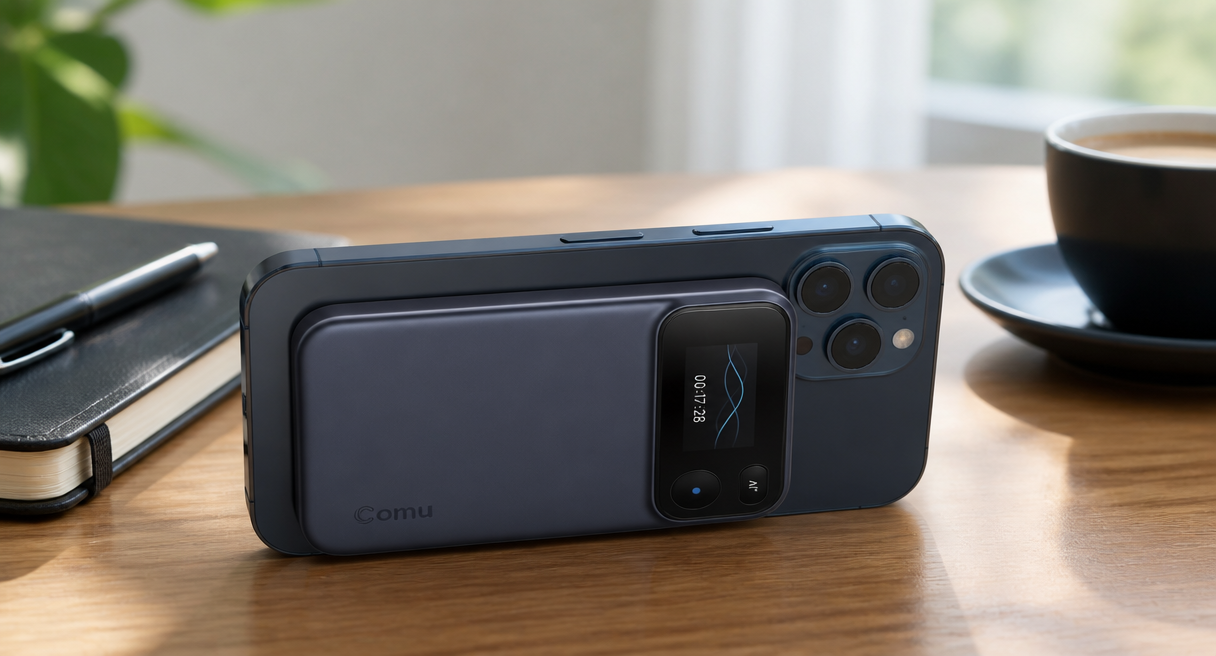
The closest Plaud Note alternatives use the same basic idea: a thin recorder that stays with the phone. That form factor is convenient for calls and mobile work, but it is not automatically the best design for conference rooms, lectures, interviews, or long multi-speaker sessions.
This guide compares the card-style route with a standalone alternative, focusing on the decisions that matter after the novelty wears off: placement, room coverage, battery life, transcription allowances, and how much work the AI can complete after recording.
Quick Answer
Choose a card-style recorder when minimum size and phone attachment matter most. Choose a standalone recorder such as Comu Action Pro when room coverage, long recording endurance, and frequent in-person meetings are the priority.
| Route | Best suited to | Main advantage | Main trade-off |
|---|---|---|---|
| Plaud Note or Plaud Note Pro | Calls, mobile recording, and users who like the Plaud ecosystem | Thin phone-attached design with a mature connected workflow | Starter transcription is limited to 300 minutes per month |
| Other card-style recorders | Buyers seeking a similar shape, attachment method, or alternative app | Familiar compact format | Recording position usually follows the phone |
| Comu Action Pro | Conference rooms, interviews, lectures, workshops, and long recording days | Dedicated six-microphone room capture and unlimited basic transcription on Starter | Separate device rather than a phone attachment |
What Makes a Good Plaud Note Alternative?
A useful alternative should solve the reason you are considering a switch. Comparing only thickness or price can hide the larger workflow differences.
| If your concern is… | Compare this first |
|---|---|
| Monthly transcription allowance | Included minutes, unlimited tiers, and overage or upgrade requirements |
| In-person meeting quality | Microphone design, pickup range, and where the device can be placed |
| Phone calls | Call-recording method, phone compatibility, cases, and participant notification |
| Portability | Thickness, weight, magnetic attachment, and whether a separate case is needed |
| Long meetings | Continuous recording time, charging method, and storage |
| Follow-up work | Summaries, action items, email drafts, documents, presentations, and export options |
Card-Style Alternatives: What You Gain
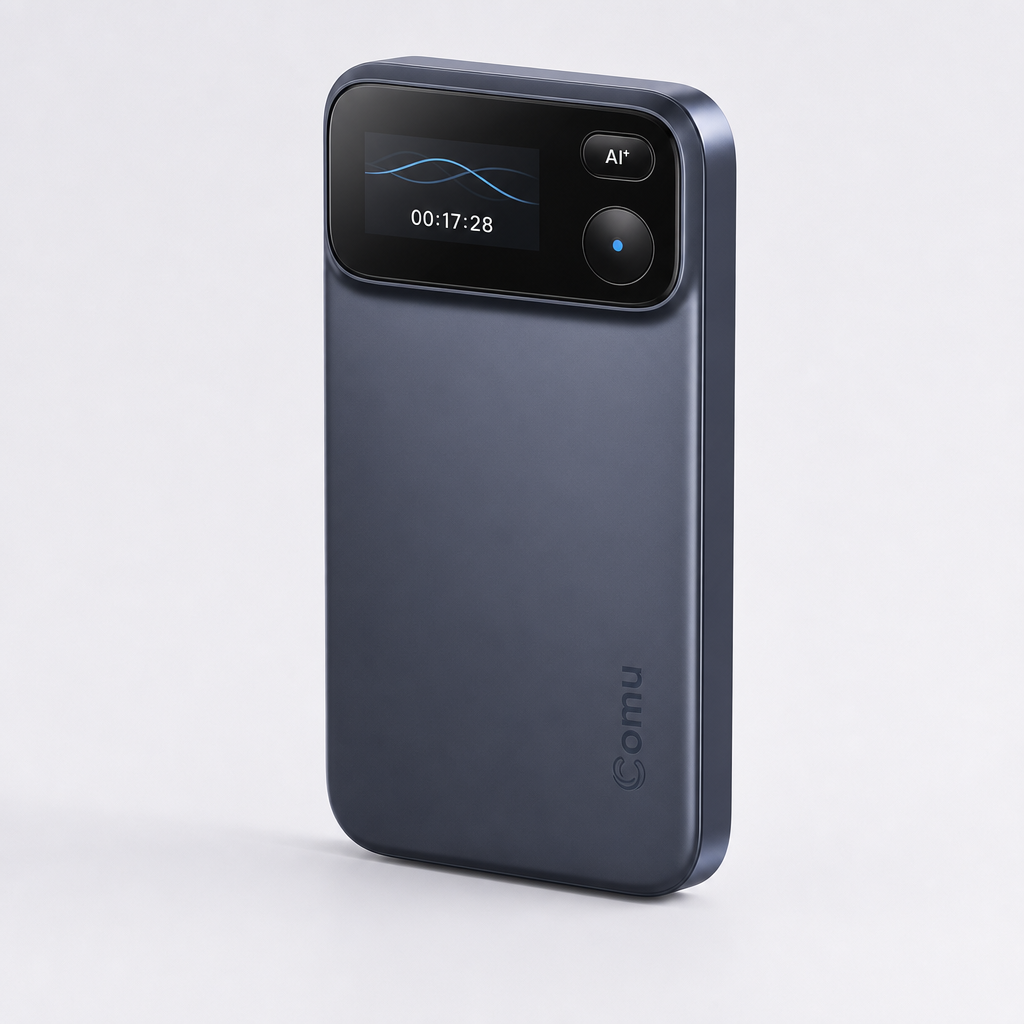
Card recorders are easy to carry because they are designed to stay with the phone. For mobile professionals, that can be more valuable than a wider pickup range.
Common benefits include:
- a thin, pocket-friendly body;
- magnetic attachment or a phone case designed for the recorder;
- quick access for calls and personal voice notes;
- fewer separate objects to remember;
- a familiar app-centered workflow.
This route is strongest for one-to-one conversations, phone calls, quick interviews, and users who keep the phone close throughout the day.
The placement trade-off
The same attachment that improves portability can restrict placement. If the phone stays beside one participant, people across the table may sound quieter. Handling the phone can also introduce movement or contact noise.
For an in-person meeting, test two positions: attached to the phone and lying flat near the center of the table. Compare distant speakers, overlapping speech, names, and figures before deciding which setup is reliable enough.
Plaud Note and Plaud Note Pro
Plaud remains the reference product for this category. Its current product ecosystem includes transcription, speaker labels, templates, Ask Plaud, exports, and access across mobile, web, and desktop.
Plaud's current Starter plan includes 300 transcription minutes per month. Pro increases the allowance to 1,200 minutes, while the Unlimited plan removes the monthly transcription-minute limit. The paid plans also expand AI and workflow capabilities.
Plaud is a strong choice when:
- you specifically want a thin card recorder;
- the phone is central to your recording workflow;
- Plaud's app, templates, and ecosystem meet your needs;
- your plan covers your monthly recording volume.
The main reason to look elsewhere is not that Plaud lacks features. It is that another form factor or plan structure may fit your meetings better.
Comulytic Note Pro and Other Card Alternatives
Comulytic Note Pro, Pocket, UMEVO Note Plus, and Genspark SecondBrain Note represent different versions of the card-recorder idea. Some emphasize sales workflows, some focus on magnetic attachment, and others connect recording to a broader AI workspace.
When comparing them, confirm current information directly with each vendor:
- phone and operating-system compatibility;
- call-recording method;
- continuous recording and standby time;
- microphone arrangement and recommended placement;
- transcription languages and monthly allowances;
- export formats and cloud storage;
- what remains available without a paid plan;
- warranty and customer-support coverage.
Avoid combining specifications from older reviews with a newer model or plan. Product names, storage configurations, accessories, and subscription terms can change even when the physical design looks similar.
When a Standalone Recorder Is Better
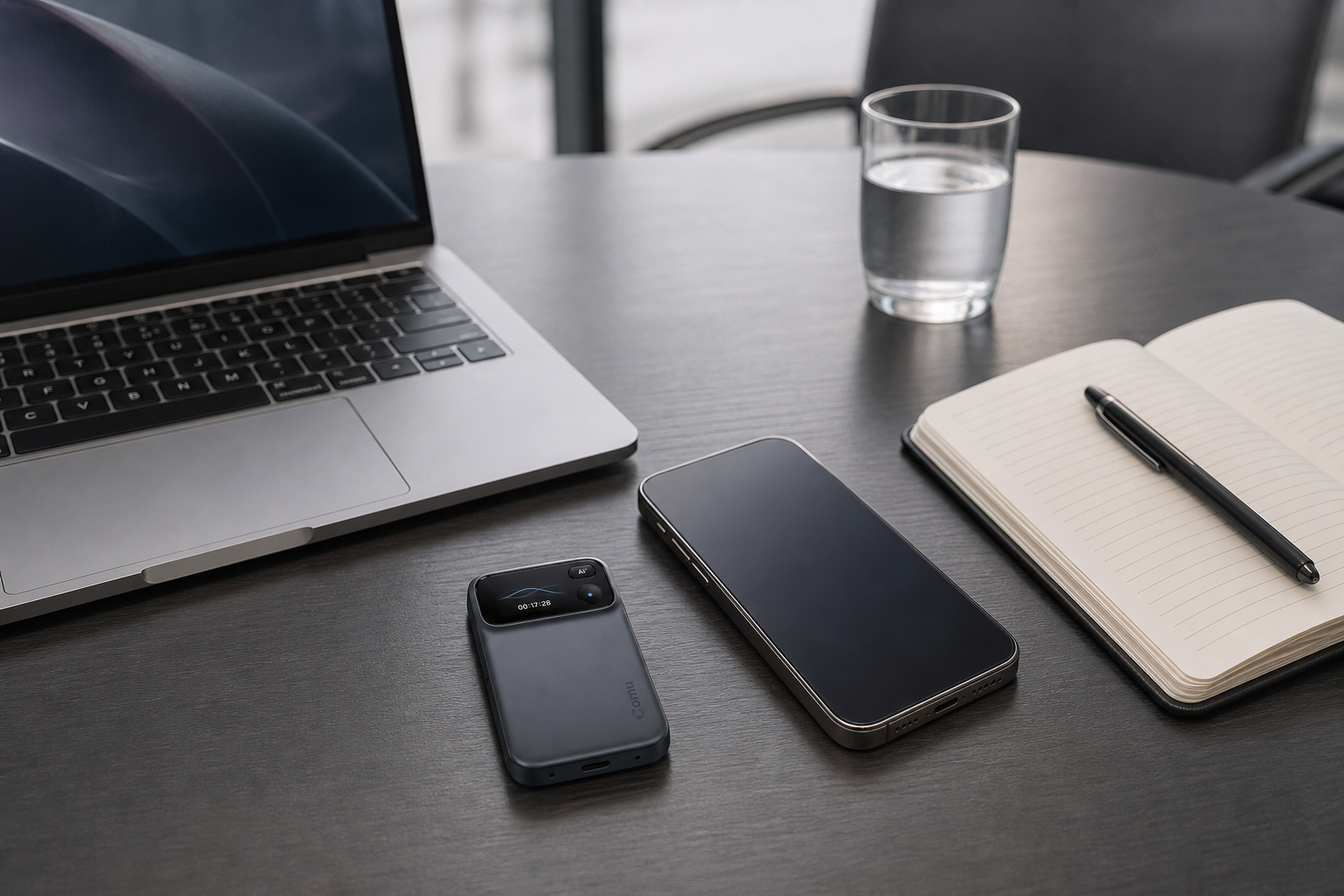
A standalone recorder is a better fit when the phone is not the natural center of the conversation. It can be placed between participants and continue recording while the phone handles calls, messages, research, or presentation control.
Comu Action Pro is our recommended upgrade path from the card category. It offers:
- a six-microphone adaptive array;
- AI voice enhancement and noise reduction;
- pickup up to 7 meters;
- up to 70 hours of recording per charge;
- transcription and translation across 113 languages;
- unlimited real-time transcription and basic summaries on Starter;
- optional AI workflows for emails, documents, presentations, action plans, and other follow-up work.
The difference is less about size than meeting geometry. A card attached to a phone is optimized for carry. A standalone recorder placed centrally is optimized for the room.
Plaud Note vs Comu Action Pro
| Comparison | Plaud Note route | Comu Action Pro |
|---|---|---|
| Form factor | Thin card designed around the phone | Standalone pocket recorder |
| Best use | Calls, mobile capture, close-range conversations | In-person, multi-speaker, and long meetings |
| Placement | Attached to or stored with the phone | Can sit independently near the center of the group |
| Published pickup | Product-specific; Plaud publishes room-capture specifications by model | Up to 7 meters |
| Published recording endurance | Varies by Plaud model | Up to 70 hours per charge |
| Free transcription | Starter currently includes 300 minutes per month | Starter includes unlimited real-time transcription |
| Basic summaries | Included according to plan | Included on Starter |
| Advanced AI | Expanded through Plaud paid plans | Expanded through Premium, Elite, and Agent Credits |
Use current official pages for exact model specifications and regional pricing.
Which One Should You Choose?
Choose a Plaud-style card recorder when:
- you want the thinnest possible device;
- the recorder should remain attached to the phone;
- calls and one-to-one conversations dominate;
- your preferred plan comfortably covers monthly usage.
Choose Comu Action Pro when:
- meetings include several people at different distances;
- you record lectures, interviews, conferences, or client visits;
- long battery life matters;
- you want unlimited basic transcription without a required paid plan;
- the output needs to become an email, document, presentation, or action plan.
Frequently Asked Questions
What is the closest physical alternative to Plaud Note?
Another magnetic card recorder is the closest match. Comulytic Note Pro, Pocket, UMEVO Note Plus, and similar devices follow broadly comparable phone-oriented formats.
Is a card recorder better for phone calls?
It can be more convenient because it stays with the phone, but compatibility and recording method vary. Test the exact phone, case, operating system, and call type you use.
Should a card recorder stay attached during a meeting?
Not always. For a group meeting, placing it flat near the center of the table may provide more balanced speaker distances than leaving it attached beside one participant.
Does Comu Action Pro require a paid subscription?
No paid plan is required for Starter, which includes unlimited real-time transcription and basic summaries. Premium and Elite are optional for advanced workflows and higher allowances.
Which option is better for a heavy meeting schedule?
We recommend Comu Action Pro when meetings are frequent, long, multi-speaker, or spread across physical locations. A card recorder may remain preferable when compactness is the main requirement.
Our Recommendation
Plaud Note remains a polished card recorder with a strong software ecosystem. Buyers who specifically want the same form factor should compare other card products on attachment, call capture, battery, app quality, and plan limits.
For users who are open to a different shape, Comu Action Pro is our recommended Plaud Note alternative for in-person work. It sacrifices phone-attached thinness in exchange for dedicated room capture, longer endurance, unlimited basic transcription on Starter, and a broader conversation-to-output workflow.
Explore Comu Action Pro, or see the Plaud alternatives hub for all three recording routes.
