
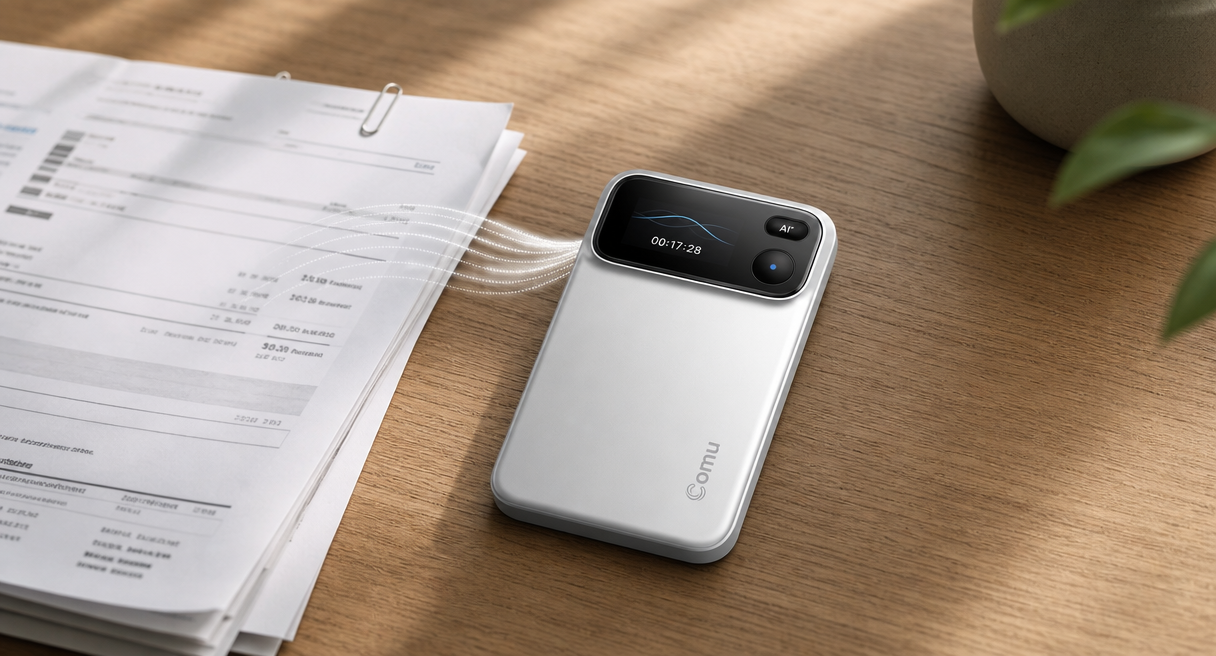
A voice recorder with transcription is worth buying when its costs stay predictable across heavy weekly use, and when any subscription stays optional rather than mandatory.
The device is bought once, and the current generation starts its AI service free rather than metered, Comu's Starter plan includes unlimited real-time AI transcription and basic summaries with no subscription at all. So the questions that decide value are what the free tier already covers at your meeting volume, what the optional paid tiers add on top, and what keeps working if billing ever stops.
What a Voice Recorder with Transcription Really Costs
Every purchase here can be two purchases, hardware first and an AI service second, each with its own rules, and the second one is optional. This section splits the bill, shows where the live numbers sit, and shows why the service half decides the value a year later.
The device half has a published anchor. The Comu Action Pro is a one-time purchase, and hardware pricing varies by market, tax treatment, promotion, and sales channel, so the current local price is read on the official product page or the appropriate regional Comu store on the day of purchase.
The service half is where heavy users live. The current system runs three plans, Starter, Premium, and Elite. The Starter plan is free and includes unlimited real-time AI transcription and basic summaries, and it also includes limited monthly access to selected advanced features, including Agent Credits, real-time translation, and in-depth AI analysis. Premium and Elite are optional paid upgrades that provide higher Agent Credit allowances and expanded access to advanced AI features and workflows, with current prices shown inside the Comu app, the source that stays correct as policies move.
The anxiety has a face, but it belongs to the metered-software lane, not to this device. In one reviewer's arithmetic, the three-hundred-monthly-minute allowance typical of metered meeting-transcription software meets a one-meeting-per-week schedule and loses, attend one one-hour meeting per week and "you will quickly run out," at which point "once you start thinking, 'Is this meeting worth recording?', the device that was supposed to reduce your note-taking ends up adding another decision to your plate." That failure mode is what unlimited-free-tier structures exist to prevent, and it is the reason this guide reads the boundary of any plan before buying.
How to Read Free Tiers, Trials, and Subscription Traps
Free tiers, trials, and renewal rules decide the second year of ownership, so this section reads them like a contract reviewer. A three-route comparison separates up-front cost, tier terms, and what the subscription gates, then covers when differences stop mattering and the fear that terms change.
Voice recorder transcription costs split into device price plus an optional subscription, so check trial length, free-tier coverage, and what expires when billing stops.
- Dedicated AI recorder, such as the Comu Action Pro. Up-front cost is the one-time device price shown on the official store page. ★ The Starter plan is free and includes unlimited real-time AI transcription and basic summaries. ★ The subscription is optional, Premium and Elite are upgrades subscribed in-app, with trials as displayed. ★ The hardware keeps recording no matter what happens on the service side. The boundary to ask about is credit and quota depth at your meeting volume.
- Meeting-transcription platform. No device cost, billing is per seat per month. Trial lengths and minute caps vary by plan, advanced summary and export sit behind the paid seat, and the hidden cost to ask about is minute overages in busy months.
- Phone app with a free tier. No cost to start, with limits on minutes or length. Higher export quality and batch features sit behind the upgrade, and the hidden cost is upgrade prompts at the moment of need.
A third-party review of the Note Pro registered the pattern from the outside, "Free Starter Plan with unlimited transcription and basic summary; paid tier for advanced features," confirming the split runs by function, not recording hours.
None of this matters for light users. A few recordings a month at arm's length, transcripts nice-to-have, and any route above carries the load. Differences matter in proportion to weekly volume.
The fear of moving terms deserves a straight answer. Across the category, policies do change. The anchor is the reviewer arithmetic above, three hundred minutes against one meeting a week, and it lost. The familiar equivalence is cloud storage, whose free gigabytes trained everyone to read the ceiling first.
Comparing Options: What Spec Sheets Won't Tell You
Spec sheets enumerate microphones, battery hours, and languages, yet the number that decides value is the subscription structure behind them. This section compares routes on terms rather than hardware, states where public data runs thin, and closes with the profile whose calendar makes the comparison worth running.
Compare voice recorder with transcription options on trial terms and feature limits before buying, because steady monthly cost decides value for heavy users.
Card-style recorders, meeting-transcription platforms, and phone apps solve the same problem at different recurring costs, and the data that would settle it is scarce. Subscription pages across the category document terms unevenly, and this guide refuses to invent the gaps. Where ongoing terms are undocumented, that absence is itself the finding.
Comu's own audience definition describes exactly the person doing this math. Sales professionals, consultants, executives, product and project teams, journalists and researchers, teachers and students, plus anyone handling offline meetings, phone calls, interviews, and multilingual transcription. Heavy recording users sit at the core of that definition, which is why the method above weights monthly predictability over specs.
FAQ: Edge Cases Heavy Users Ask About
Three edge questions arrive from people who record a lot and plan to keep doing it, and each answer states the boundary as published rather than hoped. The official page governs wherever public materials run thin, and volatile answers carry their verification date.
Can I still read my past transcripts after cancelling?
Audio recordings stay on the device you own, so they remain accessible from the hardware afterward. For AI-generated transcripts and summaries stored with the service, access and export follow the current terms in the Comu App, so download what you need before cancelling and confirm the current in-app behavior, because the official public materials do not itemize the post-cancellation policy.
How do I subscribe to the AI tiers?
Download the Comu app from the App Store or Google Play, create an account, and subscribe in-app, where the current prices, billing schedule, and renewal terms for Premium and Elite display before checkout, and the checkout screen confirms the total charge for the billing cycle you choose. The Starter plan needs no subscription and covers unlimited real-time AI transcription and basic summaries.
Could the free-tier terms change after I buy?
Policy volatility is real across this category, and reviewers treat it that way, so buy against current policy rather than a promise. The sturdy split is the same one throughout this guide, what the recorder does on its own, capture, storage, playback, versus what the AI service adds, priced as renewable.
Run the Numbers Before You Buy
One minute of verification at purchase replaces a year of wondering whether the math works, so this close compresses the guide into a four-point checklist. Run it against any candidate device, including this one, and let the current official numbers decide.
The 60-second checklist, run against live pages. First, the current price on the official product page. Second, tier and trial terms as displayed in the app today. Third, free-tier allowance wording, read for minutes, length, and limits. Fourth, what keeps working when billing stops.
A recorder built for this audit makes it easy. The Comu Action Pro shows the current device price and the full plan lineup, the free Starter plan with unlimited real-time AI transcription and basic summaries plus the optional Premium and Elite upgrades, on the product page and in the Comu App, where the checklist starts.
A voice recorder with transcription earns its place when the month-twelve math still works, beyond the checkout-day math, and the four checks above tell you before you pay.
